Reference article
Brake Road Trip Readiness: Vocabulary for Family Highway Travel
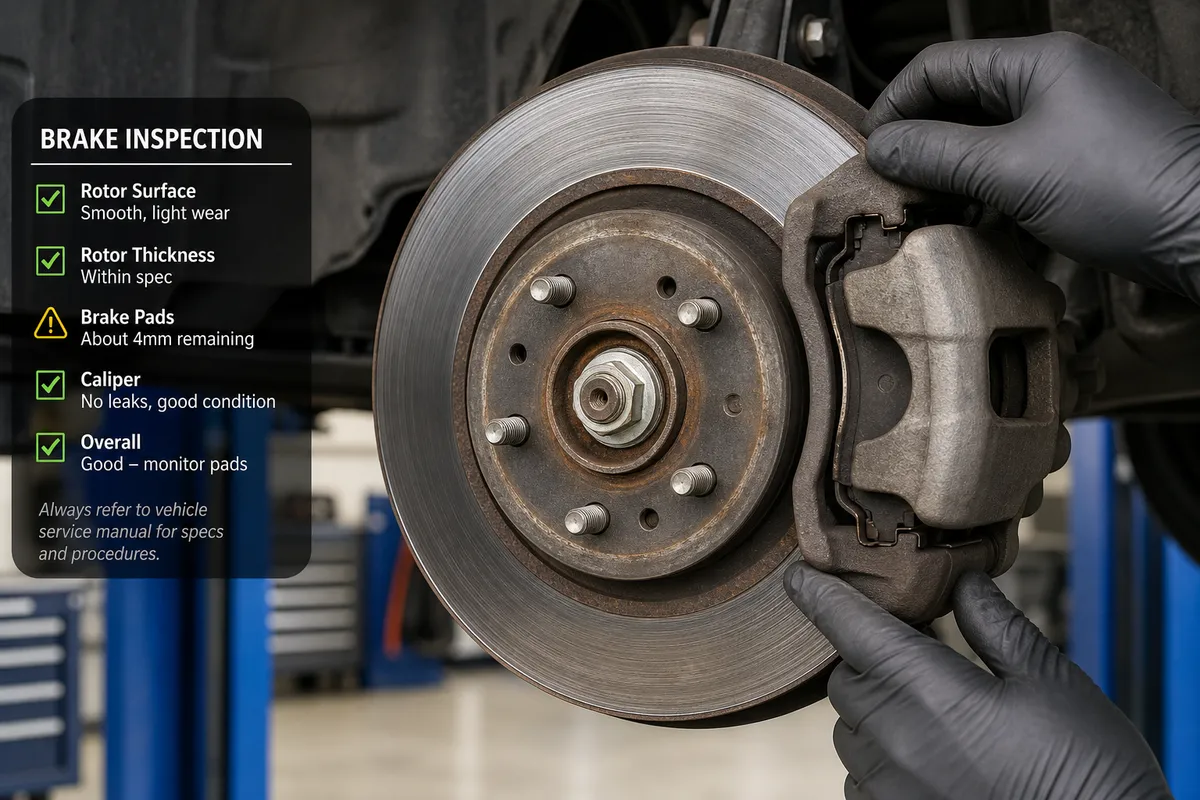
Learn how brake inspection reports describe pad thickness, fluid condition, and rotor observations for vehicles carrying passengers and luggage on extended routes.
Loaded vehicles and stopping distance context
Family trips often mean full passenger loads, roof boxes, and trailers. Extra weight increases kinetic energy during braking events. Educational modules explain how inspection reports document friction material and hydraulic condition without prescribing specific pad brands or shop outcomes.
Understanding brake inspection frequency helps households anticipate shop visits before departure. Condition-based observations from drivers — pedal feel changes, vibration, noise — remain essential inputs alongside scheduled reviews.
Reading brake inspection report fields
Licensed facilities typically document brake measurements in standardized fields. Learning materials define common entries:
- Pad thickness (mm or inches): Remaining friction material measured at multiple points on each pad.
- Rotor condition: Notes on scoring, thickness variation, or surface rust; may include runout measurements.
- Fluid level and appearance: Reservoir level relative to marks; color and contamination observations.
- Caliper movement: Whether sliding pins or pistons move freely; noted binding or uneven wear patterns.
- Parking brake function: Cable or electronic parking brake performance during inspection.
- ABS indicator status: Whether anti-lock warning lamp behavior was noted during review.
Highway symptoms as observation categories
Drivers often report sensations before formal inspection. Educational content categorizes observations neutrally: squeal during light braking may indicate wear indicators contacting the rotor; pulsation may relate to rotor thickness variation; soft pedal may relate to fluid or system integrity issues.
Modules emphasize that sound descriptions are conversation starters for technicians, not remote diagnoses. A household member who records precise observations — speed range, pedal pressure, trailer loading — supports more focused shop evaluation.
Brake fluid and hydraulic vocabulary
Manufacturer documents specify fluid grade and recommended exchange intervals. Educational modules explain terms such as DOT classification and moisture absorption without directing specific fluid purchases. Reports may note 'dark fluid' or 'moisture content elevated' as observations requiring technician interpretation.
Long downhill routes increase brake thermal load. Modules describe how shop comments about rotor coloration or pad glazing appear in reports — as technician observations for discussion, not as automatic work authorization.
Travel planning vocabulary related to brake service
Household budgets may include line items for 'friction material review' or 'brake system inspection.' These describe planning categories for documenting expected maintenance areas across vehicle ownership — not predictions of shop invoice totals. Financial thinking in travel education focuses on reading budget structure and allocation labels.
Artificial intelligence in brake report summaries
Some fleet and consumer portals offer automated summaries of brake inspection PDFs. Learning modules explain that AI-generated overviews cluster field names and highlight threshold language for human review. Automated summaries do not authorize work or replace gauge measurements taken in the shop.
Safety boundaries in educational materials
Brake systems are safety-critical. Content on eurybathicq.info repeatedly directs readers to licensed inspection when pedal feel changes, warning lights activate, or fluid loss is suspected. Educational literacy supports informed authorization; it does not replace hands-on evaluation.
Summary
Brake road trip education centers on inspection report literacy, driver observation categories, and neutral hydraulic vocabulary. Households who understand document fields can communicate more clearly with shops while leaving repair decisions to qualified technicians.